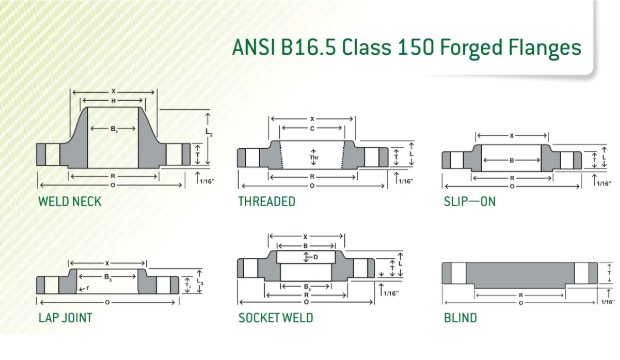
Among the various standards governing flanges, ANSI (American National Standards Institute) flanges hold a prominent position. ANSI flanges are known for their uniformity, reliability, and compatibility, making them a preferred choice in multiple industries. In this article, we will explore five different types of ANSI flanges and discuss the distinction between ANSI and ASME flanges.
Weld Neck Flanges
Weld Neck Flanges, recognizable by their long tapered neck, are a popular choice for high-pressure applications. The tapered neck, which is welded to the pipe, provides excellent strength and durability, making it ideal for critical situations. The smooth transition from the flange face to the pipe ensures minimal turbulence and pressure drop. Weld Neck Flanges are commonly used in the oil and gas, chemical, and petrochemical industries.
Slip-On Flanges
Slip-On Flanges offer easy installation and are typically used in low-pressure applications. These flanges have a flat face and a slightly larger diameter than the pipe, allowing them to slip over the pipe end and then be welded in place. They are commonly found in water supply systems, HVAC systems, and low-pressure gas pipelines.
Socket Weld Flanges
Socket Weld Flanges feature a recessed area that accommodates the pipe end, providing high strength and durability. They are well-suited for high-pressure and high-temperature applications. Socket Weld Flanges are prevalent in the oil and gas, chemical, and petrochemical industries, where they offer robust connections for critical systems.
Blind Flanges
Blind Flanges serve a unique purpose as they are solid discs used to block off the end of a pipe or valve. These flanges are ideal for applications requiring the closure of piping systems or for pressure testing. The key benefit of blind flanges is their ability to provide a tight seal, preventing leaks. They are commonly used in the oil and gas, chemical, and petrochemical industries, particularly when maintenance or inspection is required.
Threaded Flanges
Threaded Flanges have internal threads that allow them to be easily screwed onto the pipe, simplifying installation. These flanges are primarily used in low-pressure applications, where frequent dismantling and inspection are necessary. Their ease of use makes them a practical choice for various industries.
ANSI vs ASME Flanges per B16.5 and B16.47
ANSI and ASME both play significant roles in standardizing flanges, but they differ in their objectives and functions:
ANSI (American National Standards Institute): ANSI is a U.S.-based organization established in 1918, primarily responsible for overseeing national standards and accreditation systems for various products, services, processes, systems, and personnel in the United States. ANSI doesn't create its own standards but unifies and condenses existing standards for practical purposes. ANSI ensures the consistency and quality of standards for products and services. It collaborates with international entities to ensure global standards compliance.
ASME (American Society of Mechanical Engineers): ASME is one of the oldest standards-developing organizations, founded in 1880, with a focus on mechanical requirements for pressure vessel equipment. ASME develops specifications that ANSI reviews. ASME standards are widely adopted in various industries, making them prevalent in the marketplace.
Frequently Asked Questions
What are ANSI flanges, and why are they important in industrial piping systems?
ANSI flanges are components that connect pipes, valves, and equipment in industrial piping systems. They are essential for creating reliable connections in various industries.
What are the primary types of ANSI flanges, and how do they differ?
ANSI flanges come in various types, including Weld Neck, Slip-On, Socket Weld, Blind, and Threaded flanges. They differ in design, installation method, and ideal applications.
When should I use Weld Neck Flanges in my piping system?
Weld Neck Flanges are ideal for high-pressure applications due to their tapered neck and welded connection, making them suitable for industries like oil and gas.
What are the advantages of using Slip-On Flanges?
Slip-On Flanges are easy to install and are well-suited for low-pressure applications. They are commonly used in water supply systems and HVAC setups.
In which industries are Socket Weld Flanges commonly employed, and why?
Socket Weld Flanges are frequently used in high-pressure and high-temperature conditions, making them popular in industries like oil and gas and chemicals.
How are Blind Flanges used in piping systems, and what makes them beneficial?
Blind Flanges are used to close off the end of a pipe or valve and can also be used for pressure testing. They provide a secure seal, preventing leaks.
What are the key features of Threaded Flanges, and where are they typically used?
Threaded Flanges have internal threads for easy installation and are commonly used in low-pressure applications where frequent disassembly and inspection are necessary.
What is the difference between ANSI and ASME flanges?
In practice they are the same. ANSI adopted ASME B16.5 as a national standard, so ANSI B16.5 and ASME B16.5 refer to the same specification. Most engineers use the terms interchangeably.
What are the considerations for choosing the right type of ANSI flange for a project?
Consider factors like pipe size, pressure rating, material, facing type, flange type, and dimensions when selecting the appropriate ANSI flange for your application.
Conclusion
In summary, ANSI flanges offer a diverse range of connections, catering to different applications across industries. Weld Neck, Slip-On, Socket Weld, Blind, and Threaded flanges each have their unique features and advantages, allowing engineers and professionals to choose the most suitable option for their specific needs.
Understanding the difference between ANSI and ASME is also important. ANSI ensures the unification of standards and compliance for products and services, while ASME develops standards, especially for pressure vessel equipment. Both organizations have their place in the industry, contributing to the safety and quality of flanges and related components.
For more in-depth information on ANSI Flanges, visit Texas Flange.
Ready to Order ANSI Flanges?
Contact Texas Flange for competitive pricing, full material traceability, and fast delivery.
Get a QuoteRelated Articles
- Advantages of Using ANSI B16.5 Flanges in Piping Systems
- A Comprehensive Guide to ANSI Flanges: Types, Standards, and Applications
- Understanding ANSI Flange Ratings and Their Importance
- ANSI B16.5 Class 150 Flanges: The Complete Guide
- ANSI Flanges Guide: Dimensions, Specifications & Types
- Comparing ANSI Flanges to DIN Flanges
- The Future of ANSI Flange Technology